

How To Scan A Drawing Into Photoshop
Every designer'southward idea starts on paper, then transforms through software. Learn the essential steps for turning your sketch into digital art.
The sketching and ideating process is an essential stride in every designer and illustrator's workflow. Whether you lot're designing a new font, a affiche, or a unproblematic illustration, it's crucial to get your ideas down on paper earlier bringing it onto your calculator.
Read on to larn 5 essential tips to prepare your drawings for the computer, with step-by-step instructions on how to digitize your sketches in three different artistic programs: Adobe Illustrator, Adobe Photoshop, and Procreate. Plus yous'll discover additional tools to accept your sketches to the next level.

v Essential Tips to Know Before Digitizing
Before yous begin the journey to digitizing your artwork, let's get into some essential steps to assistance guide you along the way. These five tips will ensure you ever get a polish transition from paper to software.
Tip 1: Always Use Make clean White Newspaper
No matter what you're drawing, information technology's ever crucial to start out with a make clean white piece of paper. This ensures that your drawing will properly scan afterwards on. Colored papers may impede the digitizing process.

Tip 2: Refine and Clean Up Your Sketch
Many artists and designers adopt to loosely sketch ideas before refining them after on. Once you've got a solid drawing down, utilise a fine tip pen or marking to polish upward those sketchy lines. Erasers are as well your friend here, since smudges and backlog lines can frequently obfuscate your scans and interfere with the digitizing process.
Clean erasers are key—dirty erasers can muddle your drawings even more by smearing pencil atomic number 82 remnants.
Tip 3: Utilise Tracing Paper to Go Over Your Drawings
To have my drawings a step further, I like to use tracing newspaper and become over my original sketches. This type of paper is slightly translucent, giving you lot the ability to trace over your original sketches and polish upwardly your designs even more than.
For designers who prefer to have a detailed cartoon earlier moving onto the digitizing stage, this step is an absolute must.
If possible, utilize a fine-tip marker in this phase. Since you're no longer sketching and are only tracing over the finalized cartoon, sticking with a darker pen or marker is ideal, especially for scanning.

Tip four: Experiment with Scanning Your Drawing via Smartphone
For those who don't take access to a high-resolution scanner, have no fearfulness. You can achieve similar results using a scanning app on your smartphone.
For iPhone users, the Notes app creates high-quality scanned images. Simply open a new Note, click the camera icon, and select Browse Documents. Place the sketch on an even surface with decent lighting to achieve all-time results. In merely a few seconds, you'll have a crisp, clean scanned drawing that can instantly be transferred to software.
For Android users, the Adobe Scan app does only the pull a fast one on. Place your drawing on an even surface with ample lighting to let for an easy and high-quality browse. Select the camera icon, then go into Motorcar-Capture fashion to initiate the scan process.
Once scanned, this image can be touched up in Review Mode, if needed. From there, you can easily send your scanned sketch to creative software.

Tip 5: Scan Your Paper at a High Resolution
Scanning your drawings is the last step before bringing them into design software. To ensure a seamless transition from paper to software, scan your drawings at 300 PPI (pixels per inch) or more. The higher the pixels per inch, the crisper the scan will be.
A scan with a higher PPI tends to exist of higher quality due to its greater pixel density. The individual pixels in a 300 PPI image are drastically smaller than in a 72 PPI image. Smaller pixels allow for a smoother blend of colour and shape.
If y'all're turning your sketch into a vector prototype, then the pixel density isn't as of import. But if y'all're digitizing your drawing in Photoshop, the pixel density is crucial.
Once you've scanned your cartoon, transfer the scan onto a flash bulldoze for piece of cake transport to your reckoner.
Digitizing Your Sketch in Illustrator
Turning a drawing into a vector is one of my favorite techniques for bringing a cartoon to life. Adobe Illustrator's vast library of tools, colors, and effects brand digitizing a cakewalk.
Not only that, but vectors hold a greater advantage when digitizing your artwork with its infinite scalabilities, smooth curves, and smaller file sizes.

Step 1: Bring Your Scanned Image into Illustrator
In one case you lot've scanned your prototype and brought information technology onto your desktop, go ahead and create a new document within Adobe Illustrator withControl + N. Import the browse withShift + Command + P, so hitPlaceand click on an artboard to encounter your drawing pop upwardly within Illustrator.

Name the scanned cartoon layer by double-clicking Layer iinside theLayerspanel and typing in a give-and-take such as "Scan," and then add together another layer with thefolded square icon.
Do the aforementioned for the new layer and name it something along the lines of "Vector." This helps to differentiate the two layers and helps y'all runway your outline progress subsequently on.
You lot can also toggle thelock iconto lock all elements of that layer, or toggle theeye iconto turn on and off the layer visibility.
Step 2: Use the Pen Tool to Outline Drawing
On the acme layer, commencement drawing out the outline of your sketch with the handyPen Tool (P). You can either edit the Bezier curves as you movement along the cartoon, or map out the line and then become back and arrange the curves with the Anchor Point Tool (Shift + C).
To dispense private Bezier curves, hold downwardly theOption central while moving the Bezier arms.
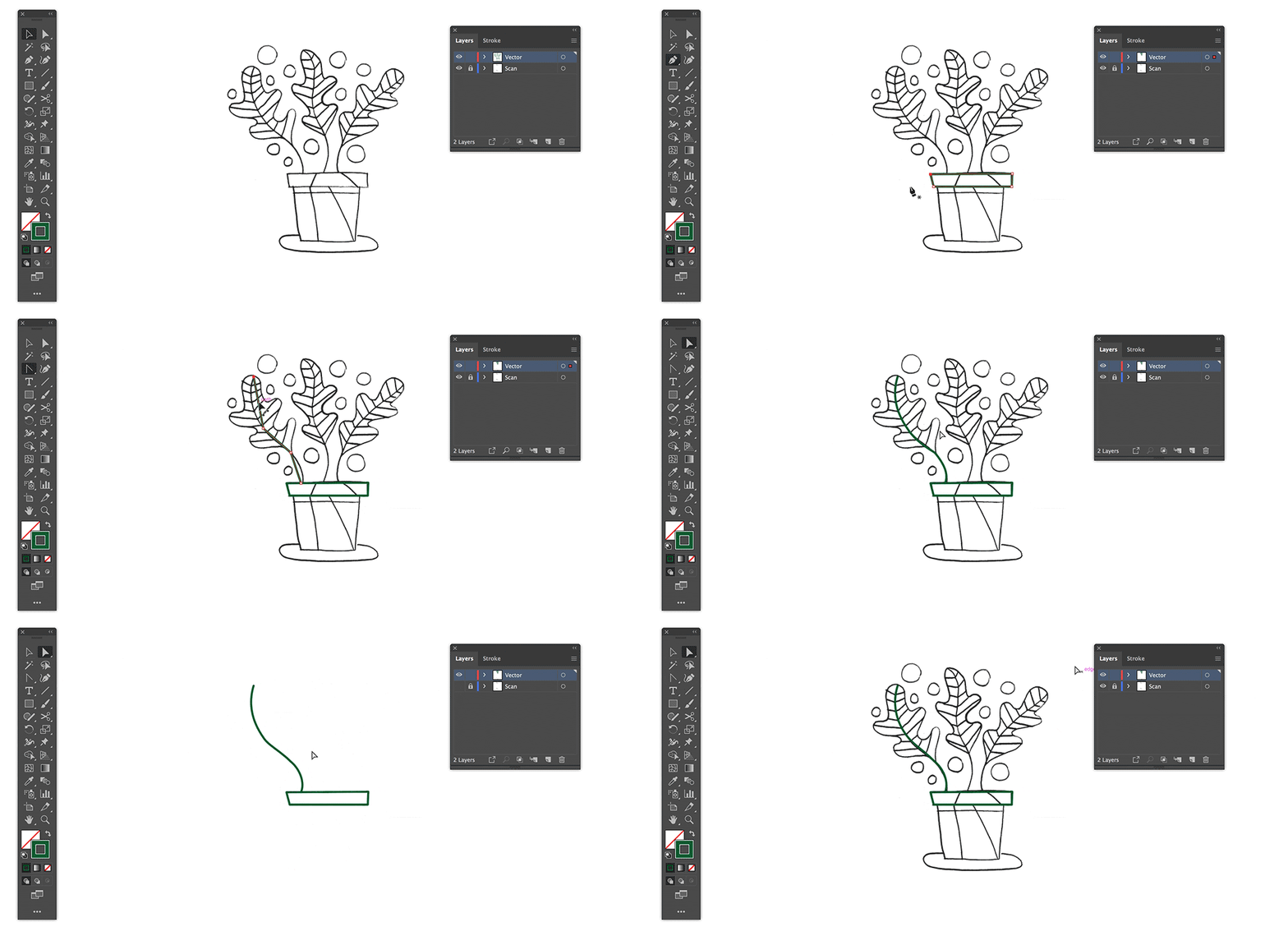
Rinse and echo until y'all've covered the entirety of your sketch. If some of your drawing contains geometric shapes, speed up your workflow by using theShapes Toolto quickly map out sketches.
Now that we've outlined the entire drawing, it's fourth dimension to add in some color.

Step 3: Fill in Color
Before assigning colour to your shapes, call back about what type of color scheme you're going for. For my plants below, I took on a muted palette to give my design that retro feel. Color is specially important in a pattern, and then accept some fourth dimension and find a few color palettes that work all-time for your composition.
Need some color inspiration? Check out these FREE 25 retro palettes, 101 colour combinations, or these 20 seasonal-themed palettes.

Once you've settled on a colour scheme, import each hue into yourSwatchespanel to make colour integration a breeze. With theSelection Tool (5), click on a shape, then choose from your color swatches to bring it into your blueprint.
Toggle theFillandStrokecolors as needed withX. To switch a stroke color to a fill up, hitShift + X. Continue assigning colors until you've filled out your design.
Accept your analogy a pace farther by experimenting with blend modes, or by incorporating gradients, textures, brushes, or grain.
Digitizing Your Cartoon in Photoshop
While the process of digitizing illustrations in Photoshop appears like to Illustrator, it's drastically different. Working in a raster-based programme means your illustration volition characteristic pixels and accept limits to scalability. Rather than outlining your drawing with Bezier curves, you can get over your sketch with brushes if you've got a tablet, or fill in those outlines with the Color Range menu.

Pace ane: Bring Your Scanned Prototype into Photoshop
Begin by dragging your scanned cartoon into the Photoshop plan. You can either right-click on the paradigm and select Open With > Adobe Photoshop, or drag the epitome on tiptop of the Photoshop icon on your desktop or toolbar. This will open upward a new document with your scanned prototype.
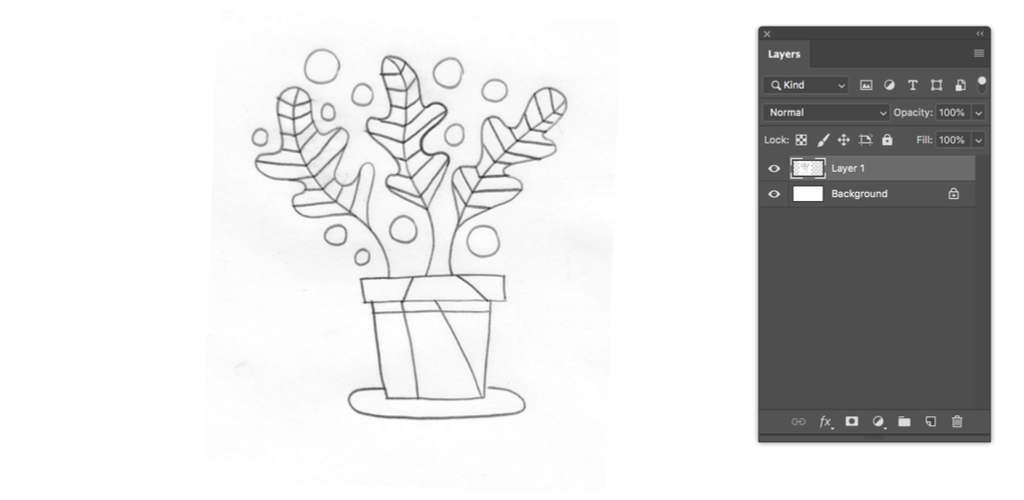
You tin can resize or rotate your scan as needed with the Costless Transform command (Control + T). Click and elevate the corners to resize or identify your cursor outside the corners to rotate.
Step ii: Adapt Dissimilarity and Levels
Since many drawings will appear a trivial calorie-free on screen, it's of import to increase the contrast and play around with the Levels and Curves.
In theLayerspanel, you can bring upwards these aligning layers by clicking on the one-half-filled circle iconand clicking Levels or Curves. Move the sliders to increase the intensity of white and black in your scanned drawing.
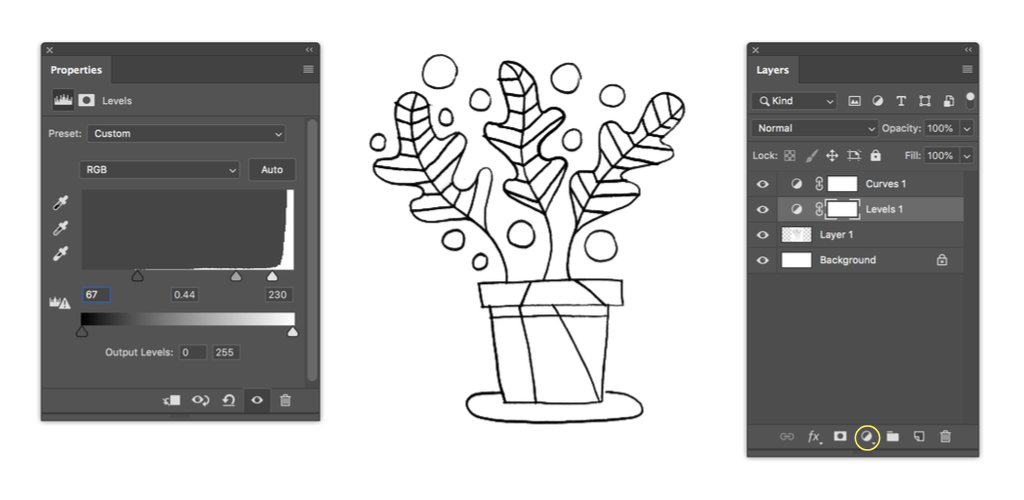
I advise playing effectually with these nondestructive adjustments to run into which ones work best for your sketch. If you're not satisfied with an adjustment, but click the layer and hit theDeletekey.
Once you lot've adapted the drawing to your liking, condense the layers downwards past Shift-clicking Layer 1 and each adjustment layer, and then hittingCommand + E.
Step three: Add Colour to Lines
Now, let'south spruce upwards your sketch with some colors. You can perform this technique in two means: with the help of Color Range to highlight the outlines in your drawing, or with the help of Photoshop's brushes. If you lot ain a tablet, you tin easily go over your original sketch with raster brushes.
Before we add some color into your illustration, add together a new layer past hitting the folded square iconin theLayerspanel. From here, you can cull to activate theCastor Tool (B)and fine-tune your brush's appearance inside theCastor Settings (F5)menu.

To become with the Color Range route, click back to your original sketch layer, and then head toSelect > Colour Range and click on the white background with the eyedropper. This selects all areas of your blueprint with white. Keep yourFuzziness down to around 12, then hitting OK.
Changed the active pick with Shift + Control + I, and so activate the new layer you just created. With theBrush Tool (B), brush over the outline with the colors of your pick. Modify the brush size as needed with [/].
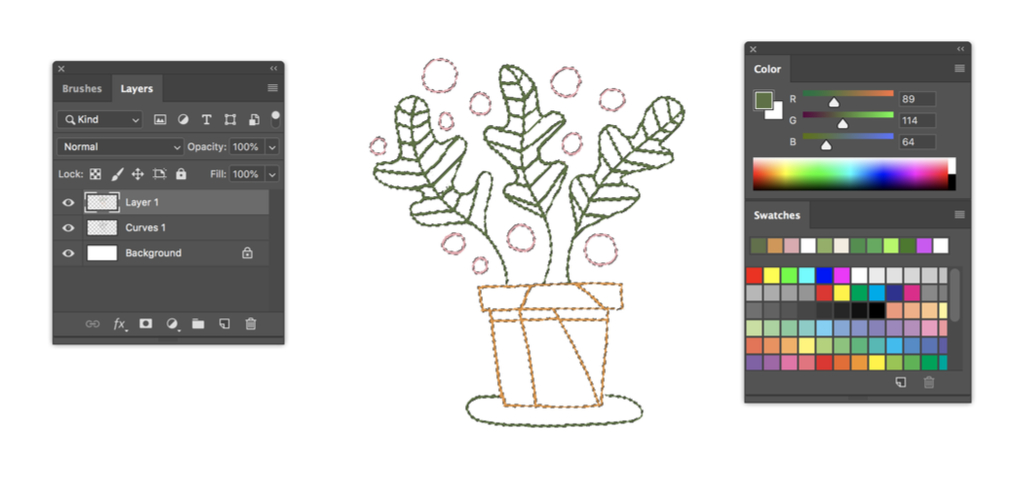
Continue filling in the outlines until you've colored all aspects of your illustration. Once you've finished, hit Command + D to remove the marching ants choice.
Step four: Make full in Rest of Color
Caput dorsum to the original drawing layer and activate the Magic Wand Tool (Westward). Click within the remaining portions of your sketch and fill it in with theBrush Tool (B) on the layer above your original sketch layer. This makes sure you're non coloring directly on the original drawing. Instead, you lot're adding color to a separate layer.
Continue adding color until you've filled out the entire sketch.
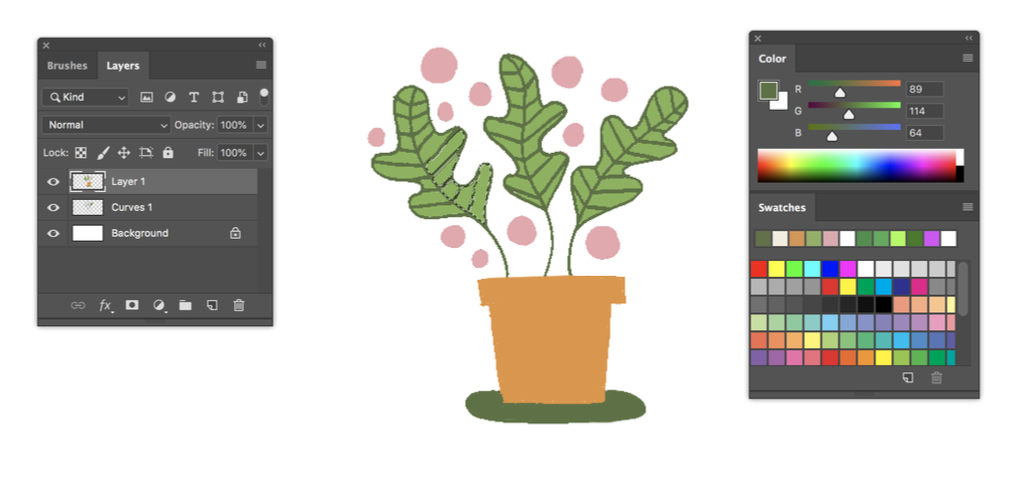
Choice Tip: When making multiple selections at a fourth dimension, hold downwards theShift key. To remove selections, hold downward theOption fundamental.
Working with Sketches in Procreate
The Procreate app is a powerful application designed for drawing, illustrating, and prototyping artwork. It closely resembles the setup of Photoshop in regards to its brush library, layer modes, diverse effects, and raster profile. Simply, with its countless features, tools, and brushes, this digital illustration app is in a league of its ain.
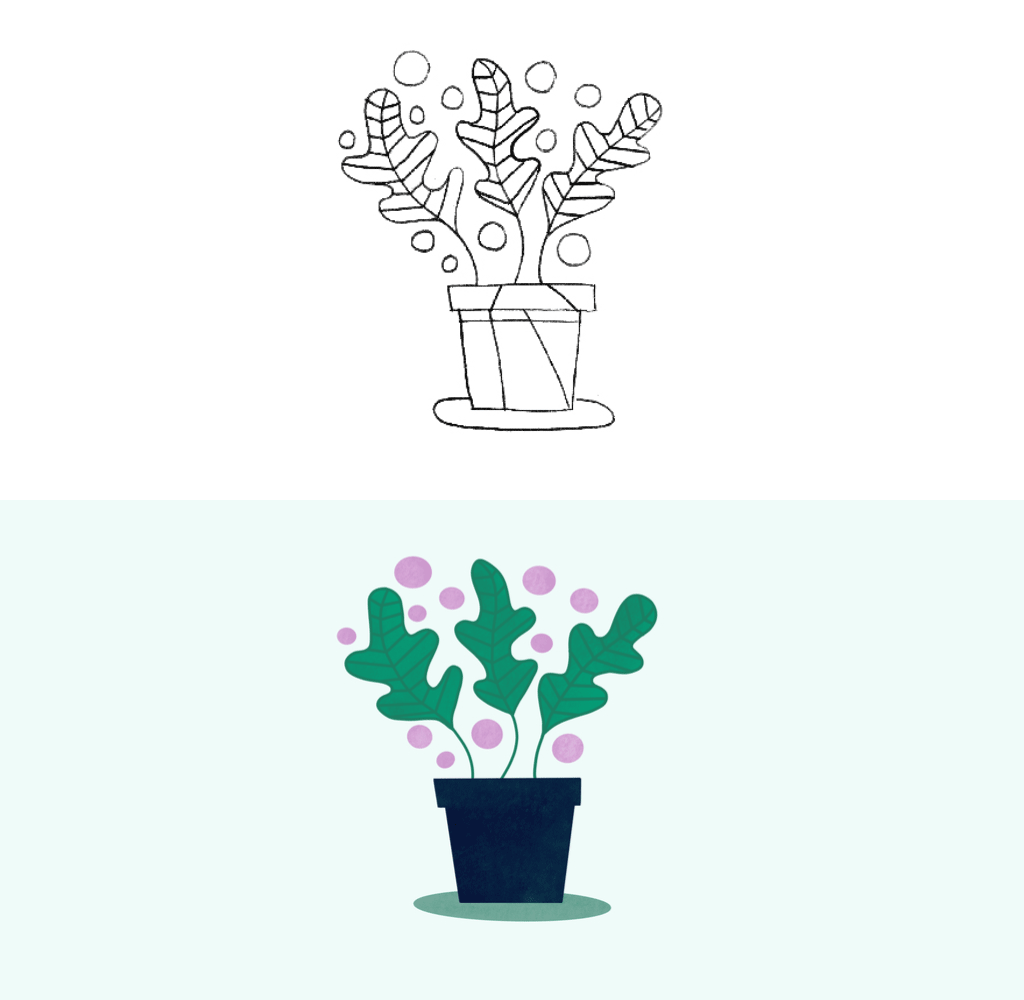
Procreate makes the digitizing process experience natural. With the stylus, it tracks the amounts of force per unit area applied and the angle it'southward used at, mimicking the feel of true pen and newspaper.
For an in-depth breakdown on the Procreate app, look through this handy guide.
Step one: Import Drawing into Procreate
Begin by importing your sketch into the Procreate programme. The image tin be made by taking a photo of the illustration, or can be transferred to your iPad from an electronic mail.
I simply took a photo of the sketch, since the quality of the image doesn't matter when drawing over the original sketch. In Procreate'south chief carte, select Photo, then choose your drawing from the Camera Whorl. Procreate will automatically create a new document containing your prototype.
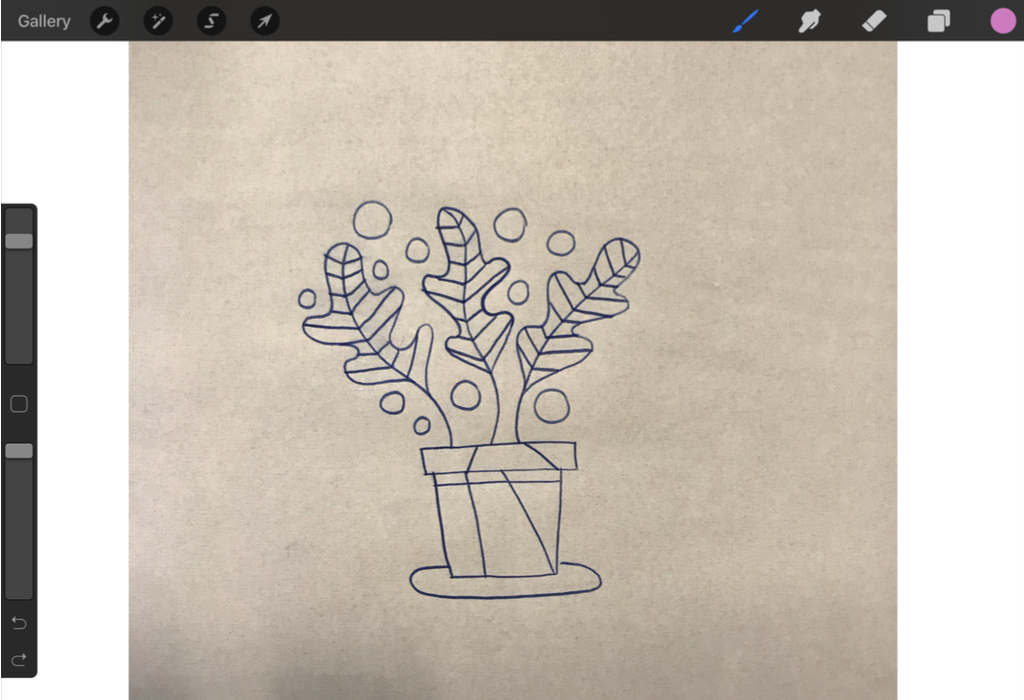
In one case you've imported your image, resize or rotate the paradigm (equally needed) by selecting thepointer iconat the tiptop toolbar. SelectUniform, then drag the blue corners (as necessary) to resize the image. HitRotate 45 degreesto rotate your paradigm inside the document.
Step 2: Utilize Brushes to Outline
This is where all the fun begins. TheBrushes menu is inarguably one of the all-time aspects of Procreate. Select the pigment brush icon at the summit of the program to open up the castor library. At that place are tons of default brushes at your finger tips—pencils, textured brushes, and more.
Before tracing over your original cartoon, create a new layer by clicking the plus signin theLayerstab. Keeping your layers consistent and organized is crucial here.
For each unlike shape, create a new layer and rename that layer accordingly. To name your layer, click on the layer thumbnail and select Rename.
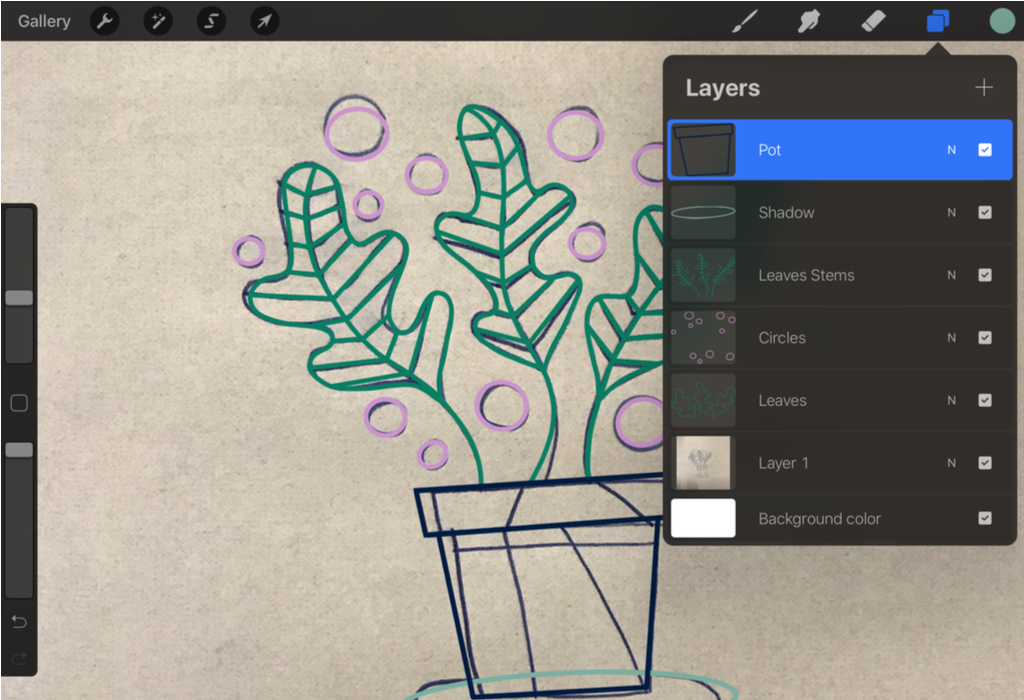
To create a uncomplicated outline, I opted for theMonoline Brushin theCalligraphysection. Experiment with unlike brush types to come across what works best for your illustration. Y'all can fine-tune the brush settings by clicking on the brush name.
Click on the circumvolve shape at the top of the programme to admission your colors. In that location are diverse ways to modify colors within the Procreate app. You lot can browse through hues inside theDisc,Classic,Value, andPalettestabs.
Footstep 3: Fill in Residue of Colour
Procreate'south way of filling in color is through theColorDroptechnique. Merely activate the layer y'all'd similar to apply the active color to, then click and elevate the circle to the enclosed space.
If the outline is enclosed, the colour drop will make full the space. If the outline is partially open, the colour fill volition spread to the entire layer.
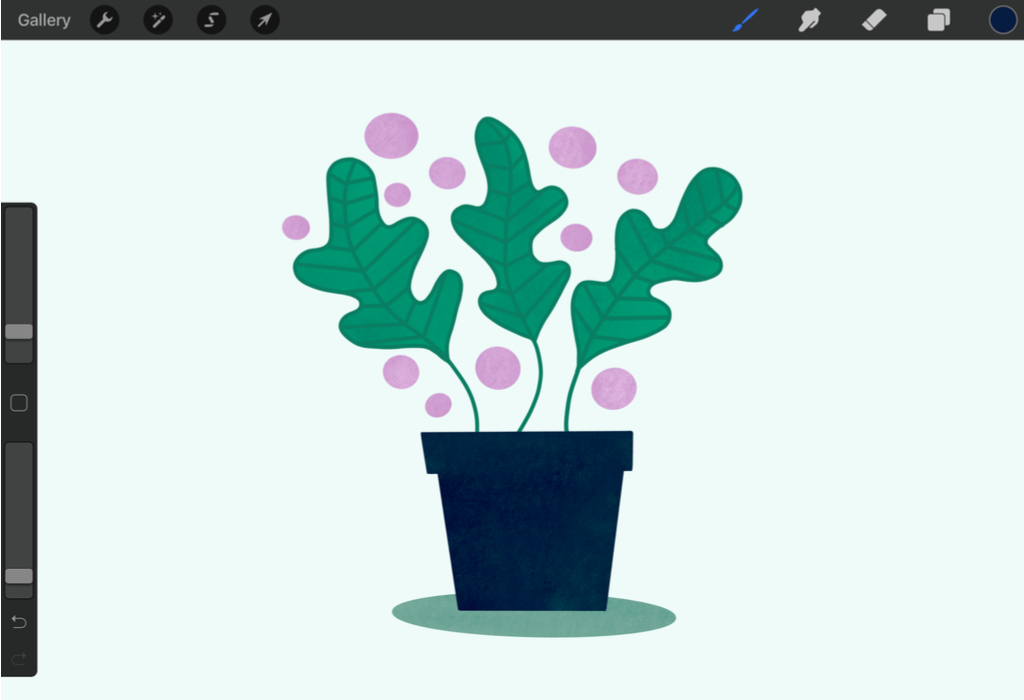
Rinse and echo for the remaining shapes. To bring in some textural elements, activate theBlastoff Lockcommand within the layer thumbnail and draw with a Charcoal or other textured brush.
While Illustrator, Photoshop, and Procreate are tools and software I often use when digitizing my drawings, there are also boosted tools that can empower you to take your drawings from paper to the screen.
1. InkScape
InkScape, a free vector-editing software program, is a prissy option when Adobe Illustrator isn't available. Existence a vector-based programme, your traced designs aren't bound to the limitations of raster pixels.
2. CorelDRAW
A more affordable choice than Adobe Creative Deject is CorelDRAW. The software programme boasts vector illustration tools in addition to raster photo editing tools, much like Photoshop.
3. Vectornator
Another professional vector-based software program is Vectornator. With its endless tools and features, yous can easily take your scanned sketch to the next level with Vectornator's Pen Tool, Shapes Tool, Brush Tool, and more.
Cover image via GrandeDuc.

Source: https://www.shutterstock.com/blog/digitizing-art-guide#:~:text=Begin%20by%20dragging%20your%20scanned,your%20scanned%20image%20into%20Photoshop.
Posted by: deboermosedince42.blogspot.com
0 Response to "How To Scan A Drawing Into Photoshop"
Post a Comment